


A multiparameter water quality meter allows you to measure several chemical and physical properties of a water sample in a single device. Instead of running separate tests for each parameter, you get results for multiple indicators at once, saving time and reducing the number of instruments on your bench.
The Hanna Instruments HI83300 family is a line of benchtop photometers built for exactly this purpose. These meters use colorimetric analysis based on the Beer-Lambert principle to measure water quality parameters such as chlorine, ammonia, iron, phosphate, nitrate, and many more. Every model in the family also doubles as a laboratory-grade pH meter through a digital electrode input, so a single device handles both photometric and electrochemical measurements.
With seven application-specific models, the HI83300 family covers water treatment, wastewater, aquaculture, pool and spa maintenance, nutrient analysis, and general laboratory testing. Each meter is compact enough for field use with a rechargeable lithium-ion battery and accurate enough for regulated lab work.


HI83300 family is designed with an innovative optical system that incorporates a beam splitter so that light can be used for absorbance readings and by the reference detector. The reference detector monitors the intensity of light and modulates when there is drift due to power fluctuation or the heating of the optical components. Each part has an important role in providing unparalleled performance from a photometer.

An LED light source offers superior performance as compared to a tungsten lamp. LEDs have a much higher luminous efficiency, providing more light while using less power. They also produce very little heat, which could otherwise affect the optical components and electronic stability.
A beam splitter is used as part of the internal reference system of the HI83300 photometer. The reference detector compensates for any drift due to power fluctuations or ambient temperature changes. Now you can rely on a stable source of light.
The sample cell of the HI83300 fits a round, glass cuvette with a 25 mm path length. Along with the advanced optical components, the larger size of the cuvette greatly reduces errors in rotation from the indexing mark of the cuvettes. The relatively long path length of the sample cuvette allows the light to pass through more of the sample solution, ensuring accurate measurements even in low absorbance samples.
The narrow band interference filter not only ensures greater wavelength accuracy (±1 nm) but is also extremely efficient, allowing a brighter, stronger signal to be transmitted. The end result is increased measurement stability and less wavelength error.
Adding a focusing lens to the optical path allows for the collection of all of the light that exits the cuvette and focusing the light on the silicon photo detector. This innovative approach to photometric measurements cancels the errors from imperfections and scratches present in the glass cuvette eliminating the need to index the cuvette.

Plugging in an electrode has never been easier; there are no alignment issues or broken pins. Any of our digital pH electrodes can be connected by a 3.5 mm input.
Equipped with a rechargeable lithium ion battery, these meters can be portable for measurements on the move. Battery life lasts up to 500 photometer measurements or 50 hours of continuous pH measurements. The auto-off feature automatically shuts the meter off after 15 minutes of inactivity. A power supply can be plugged into the micro USB port at the back of the meter for benchtop use.
Both the USB and micro USB port can be used to transfer data via flash drive or direct connection to a PC or MAC. Data is transferred as a CSV file.
Measure pH and temperature with a single probe. Good Laboratory Practice (GLP) to track calibration information including date, time, buffers used, offset and slope for traceability. pH CAL Check™ alerts user to potential problems during the calibration process. Space saving having a pH meter and photometer built into one meter
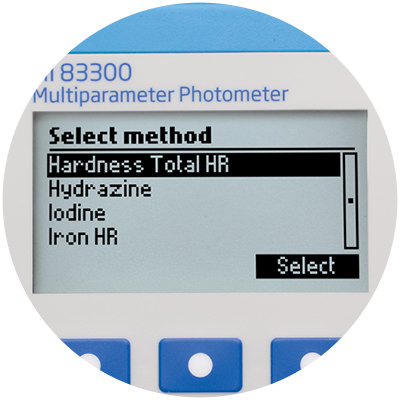
Users can access the menu of measurement methods with the simple press of a button. Low, medium, and high range methods of several parameters are available for users to obtain a high accuracy reading. Each method is assigned a concentration unit of measure. Parameters can be expressed in different chemical forms based on user preference.

The sample cell of these meters fits a round, glass cuvette with a 25 mm path length. The relatively long path length of the sample cuvette allows the light to pass through more of the sample solution, ensuring accurate measurements even in low absorbance samples. This cuvette size also provides a larger opening, making it easier for users to dispense ready-made liquid or powder reagents into the sample.
An affixed, light-blocking cover panel closes over the sample cell, reducing stray light from affecting any measurement readings.

The HI83300 family offers the ability to connect a digital pH electrode. Users can connect any sensor from our extensive line of digital pH electrodes. Whether a user requires a glass or plastic body, a spheric or conical tip shape, or the ability for safe use with food samples, our digital electrode offering is suitable for nearly everyone.

Users can select to calibrate and measure samples in absorbance mode for each wavelength used by the meter. This mode is a convenient way for users to develop their own calibration curves and measure samples with customized chemistries.

Hanna’s exclusive CAL Check feature allows for performance verification of the independent measuring channels. Our CAL Check standard vials are developed to simulate a specific absorbance value at each wavelength to verify its accuracy.
Reaction time is of key importance when performing colorimetric measurements, which is why the built-in timer of the HI83300 is a key feature. The countdown timer displays the time remaining until a measurement will be taken, ensuring consistent results between measurements and users.
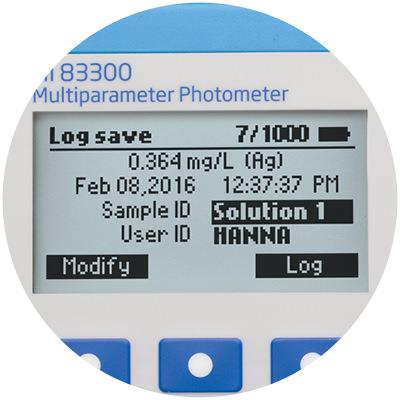
The HI83300 family can store up to 1000 photometer and pH electrode readings, which can be logged by pressing the LOG key on the face of the meter. pH readings are logged along with comprehensive GLP (Good Laboratory Practice) information such as date, time, calibration buffers, and electrode offset and slope.
An alphanumeric keypad can be used to enter sample ID and user ID to be stored with the measurement reading. The recall key allows the user to review the data along with the date and time that the reading was taken.
Two USB ports are provided for transferring data. One port allows the data to be transferred to a flash drive while the other USB is used for direct connection to a computer. All data is transferred as a .CSV file that can be used with many spreadsheet programs for documentation.

A backlit, graphic LCD display provides an easy to read, user-friendly interface.
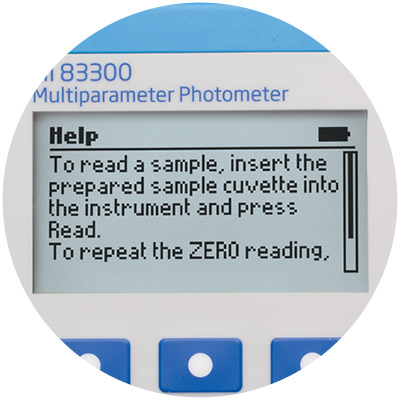
With virtual keys, a battery status indicator, and practical error messages, users will find the meter interface intuitive. On-screen guides provide information relating to the current meter operation, and can be used at any stage in the setup or measurement process to show contextual help.
The HI83300 family of multiparameter photometers features seven models to cover a wide variety of applications. These meters are compact and versatile making them ideal for both benchtop or portable operation.

Since 1978, Hanna has introduced instruments that tailor to the needs of a specific application or industry. From this philosophy we have created Application Designed Photometers.
Accurate water quality testing depends heavily on the optical system inside the meter. A poorly designed photometer introduces measurement drift, wavelength errors, and inconsistent readings between users. Here is what sets the HI83300 family apart from standard benchtop photometers.
The HI83300 uses a beam splitter to direct light to both the sample and an internal reference detector. The reference detector continuously monitors light intensity and compensates for any drift caused by power fluctuations or temperature changes. This means your readings stay stable whether the meter has been running for five minutes or five hours.
Unlike older photometers that rely on tungsten lamps, the HI83300 uses LED light sources. LEDs produce a stronger signal with less power, generate almost no heat, and last much longer than traditional bulbs. Less heat also means less interference with the optical components and electronics.
A larger cuvette allows light to pass through more of the sample solution. The 25 mm round glass cuvettes used in the HI83300 reduce rotation errors from indexing marks and provide accurate readings even in samples with low absorbance. The wider opening also makes it easier to add liquid or powder reagents during sample preparation.
The interference filter provides wavelength accuracy of ±1 nm, which is far tighter than what many portable photometers can achieve. A narrow bandwidth allows a brighter, stronger signal to reach the detector, resulting in better measurement stability and lower wavelength error.
A focusing lens collects all the light exiting the cuvette and directs it onto the silicon photo detector. This design cancels errors caused by scratches or imperfections in the glass cuvette, removing the need to align or index the cuvette before every reading.
Each model in the HI83300 family is designed for a specific industry or application. The table below summarises the key differences to help you choose the right multiparameter meter for your needs.
Model | Application | Parameters | Methods | Key Tests |
General Lab / Multi-Industry | 37 | 60 | Chlorine, ammonia, iron, nitrate, phosphate, hardness, COD, and more | |
Aquaculture | 12 | 20 | Alkalinity, calcium, nitrite, phosphate, ammonia, dissolved oxygen | |
Wastewater (with COD) | 10 | 20 | COD, total nitrogen, total phosphorus, ammonia, chlorine | |
Nutrient Analysis / Agriculture | 8 | 9 | Potassium, calcium, magnesium, ammonia, nitrate, sulfate | |
Pool & Spa | 11 | 12 | Free chlorine, bromine, cyanuric acid, alkalinity, hardness, iron | |
HI83399 | Water Treatment | 36 | 60 | Chlorine, fluoride, manganese, turbidity, ozone, silica |
HI83308 | Boilers & Cooling Towers | 14 | 22 | Hardness, iron, silica, copper, alkalinity, oxygen scavengers |
If you are unsure which model fits your application, the HI83300 is the most versatile option. It covers 37 parameters with 60 methods, making it suitable for labs that test across multiple industries.
Every HI83300 family meter includes a 3.5 mm digital pH electrode input. You can connect any Hanna digital pH electrode and measure pH and temperature alongside your photometric tests. This saves bench space and reduces equipment costs, since you no longer need a separate benchtop pH meter.
The pH measurement mode includes Good Laboratory Practice (GLP) features that record calibration date, time, buffers used, electrode offset, and slope. The pH CAL Check system alerts you to potential problems during calibration, such as a contaminated buffer or aging electrode.
The HI83300 family runs on a rechargeable lithium-ion battery that provides up to 500 photometer measurements or 50 hours of continuous pH readings on a single charge. An auto-off feature shuts the meter down after 15 minutes of inactivity to preserve battery life.
For permanent lab setups, a power supply connects through the micro USB port at the back of the meter. This dual-power design means you can take the same instrument from the lab bench to a field site without switching devices.
Each meter stores up to 1,000 photometer and pH readings. You can tag every measurement with a Sample ID and User ID using the built-in alphanumeric keypad, which makes traceability straightforward in multi-user labs.
Two USB ports handle data transfer. The standard USB port accepts a flash drive for quick export, while the micro USB port allows direct connection to a PC or Mac. All data exports as a CSV file that opens in any spreadsheet application.
Feature | Details |
Optical System | LED light source, beam splitter, reference detector, narrow band interference filter (±1 nm), focusing lens |
Cuvette | 25 mm round glass cuvette with light-blocking cover panel |
pH Input | 3.5 mm digital electrode connector with GLP data logging |
Battery | Rechargeable lithium-ion; up to 500 photometric readings per charge |
Data Storage | 1,000 readings with Sample ID and User ID tagging |
Data Transfer | USB flash drive or direct USB-to-computer; CSV export |
Display | Backlit graphic LCD with on-screen help guides and virtual keys |
CAL Check | NIST-traceable standards for independent channel verification |
Absorbance Mode | Available for custom calibration curves and performance verification |
Reaction Timer | Built-in countdown timer for consistent colorimetric results |
The HI83300 benchtop photometer family is used across a wide range of industries and applications:
If you need to test for specific known parameters using pre-programmed methods, a benchtop photometer from the HI83300 family is the practical choice. These meters are ready to use out of the box with reagent-based methods and give you direct concentration readings.
If you require wavelength flexibility for custom methods, research applications, or regulatory protocols that demand full spectral scanning, consider the Hanna iris HI801 spectrophotometer. The iris covers a spectral range of 340 nm to 900 nm with 1 nm resolution and supports user-created methods.
For quick single-parameter spot checks in the field, portable photometers and Checker HC colorimeters offer a more compact and affordable option.
The most common parameters include pH, chlorine (free and total), ammonia, nitrate, nitrite, phosphate, iron, hardness, alkalinity, dissolved oxygen, turbidity, and COD. The exact list depends on the model. The HI83300, for example, covers 37 different parameters across 60 measurement methods.
For pre-programmed reagent methods, benchtop photometers and spectrophotometers produce comparable accuracy. The HI83300 family achieves wavelength accuracy of ±1 nm, which is close to the ±1.5 nm of the Hanna iris spectrophotometer. The main advantage of a spectrophotometer is the ability to select any wavelength in its range, which matters for custom or research methods.
Yes. The rechargeable lithium-ion battery supports up to 500 measurements per charge, and the compact size makes it easy to transport. Many users take these meters to remote field sites for on-the-spot water quality testing.
Yes. Reagents are sold separately and are specific to each parameter and method. This allows you to purchase only the reagents you need for your testing requirements.
You can transfer data using a USB flash drive or by connecting the meter directly to a PC or Mac via the micro USB port. All measurement data exports as a CSV file.
Since 1978, Hanna Instruments has designed and manufactured analytical testing equipment for laboratory, industrial, and field applications. Every instrument is built in-house, from the circuit boards to the glass electrodes, across manufacturing facilities in Europe and the United States. Hanna holds both ISO 9001 and ISO 14001 certifications. Learn more about Hanna Instruments.
Need help choosing the right multiparameter meter for your application? Contact our team in Singapore at (65) 6296-7118.
To empower customers to achieve quality
by supplying intuitive, accurate, and reliable analytical instruments with exceptional customer service and value.
We take pride in every product we build. From an original idea, to a completed product ready for testing. We oversee every aspect of the manufacturing process. It is this level of attention to detail that sets us apart.

