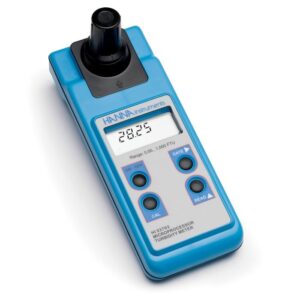
A turbidity sensor measures how much light is scattered by suspended particles in a water sample. The higher the particle concentration, the cloudier the water appears and the higher the turbidity reading. These measurements are used daily in drinking water treatment, wastewater discharge monitoring, food and beverage production, and environmental field studies.
Hanna Instruments manufactures turbidimeters that follow two internationally recognized test methods. Each method uses a different light source and reports results in its own unit of measure, so choosing the right instrument starts with knowing which standard your application requires.
Turbidity sensors work by directing a beam of light through a glass vial filled with the water sample. A detector positioned at 90 degrees to the light source picks up scattered light. A microprocessor then converts that signal into a numerical turbidity value. What separates one method from the other is the wavelength of light and the way the reading is calculated.
The ISO 7027 standard, titled “Water Quality: Determination of Turbidity,” specifies an infrared LED as the light source. Because infrared light is outside the visible spectrum, colour interference from dissolved substances like tannins or dyes is minimized. Results are reported in FNU (Formazin Nephelometric Units) or FTU (Formazin Turbidity Units). This method is widely adopted across Europe and Asia for drinking water and surface water testing.
The US Environmental Protection Agency Method 180.1 uses a tungsten lamp that emits light in the visible spectrum. Results are reported in NTU (Nephelometric Turbidity Units). This is the required method for regulatory compliance in the United States and is also used in laboratories that follow Standard Method 2130 B. EPA-compliant turbidimeters are commonly used for drinking water, saline water, and surface water analysis in a 0 to 40 NTU range.
Feature | ISO 7027 | EPA 180.1 |
Light source | Infrared LED (860 nm) | Tungsten lamp (visible spectrum) |
Reporting units | FNU / FTU | NTU |
Colour interference | Minimal (infrared bypasses colour) | Possible with coloured samples |
Primary regions | Europe, Asia, international | United States |
Typical applications | Drinking water, surface water | Drinking water, saline water, surface water |
Calibration standards | AMCO-AEPA-1 formazin | AMCO-AEPA-1 formazin (NIST traceable) |
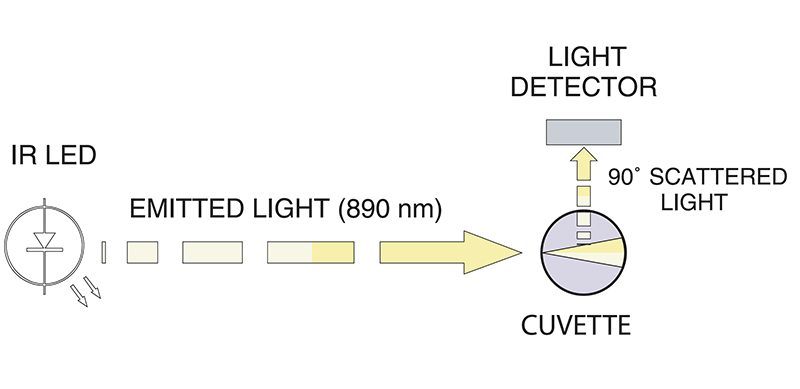
The USEPA Method 180.1 specifies the key parameters for the optical system to measure turbidity for drinking, saline and surface water, in a 0 to 40 NTU range, using the nephelometric method. Meters compliant with EPA approved methods are designed to meet or exceed the criteria specified by the USEPA Method 180.1 and Standard Method 2130 B.
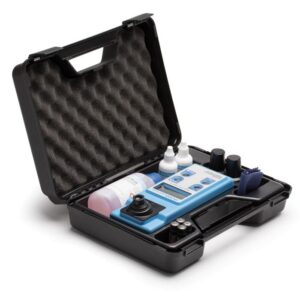
Hanna Instruments offers a wide variety of instrumentation for measuring turbidity. Products include benchtop and portable meters that are based on ISO and EPA methodology. Specialized portable meters are available for monitoring bentonite in wine and haze in beer.

Benchtop turbidity meters include versions based ISO and EPA methods. Meters based on the EPA method have NTU, Nephelos, and EBC as units of measure. A benchtop based on the EPA method is also available to measure chlorine. Meters based on the ISO method can display results as FNU, FAU, NTU, and EBC.
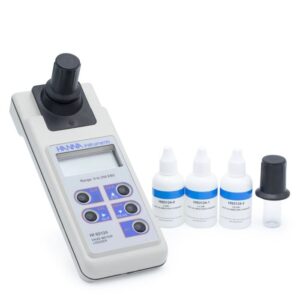
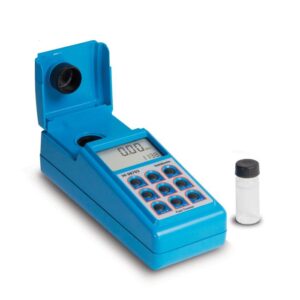
Portable turbidity meters include versions based ISO and EPA methods. Meters based on the EPA method display results as NTU. A portable meter based on the EPA method is also available to measure chlorine. Meters based on the ISO method display results as FNU. In this category are portables that can measure additional parameters along with turbidity and a version made for bentonite monitoring in wine and haze in beer. The haze meter that can display results as FTU, EBC, ASBC, and HELM.
Selecting a turbidimeter depends on three main factors: the test method your regulations require, whether you need a fixed lab instrument or a field-ready portable, and what additional parameters you may want to measure alongside turbidity.
If your lab or facility operates under European or Asian water quality guidelines, an ISO 7027-compliant turbidity sensor reporting in FNU is the correct choice. If you need to meet US EPA regulations or report results in NTU, choose an EPA 180.1-compliant model.
Benchtop turbidimeters are designed for laboratory use where high throughput and maximum precision matter. They sit on a stable surface and typically offer broader measurement ranges and additional display units like EBC for brewing applications. Portable turbidity sensors are battery-powered and built for field sampling at water treatment sites, rivers, reservoirs, and industrial discharge points.
Some applications only call for turbidity. Others require simultaneous readings of turbidity, chlorine, pH, dissolved oxygen, or conductivity. Hanna offers single-parameter turbidimeters as well as multiparameter meters that combine turbidity with other water quality measurements in one device.
Benchtop turbidity meters from Hanna include models based on both ISO and EPA methods. EPA-based benchtop meters display readings in NTU, Nephelos, and EBC. A dedicated benchtop model is also available for combined turbidity and chlorine measurement, which is especially useful in drinking water laboratories. ISO-based benchtop meters can display results in FNU, FAU, NTU, and EBC.
Key features across the benchtop range include up to four-point calibration with AMCO-AEPA-1 primary standards, a positive-locking cuvette system that prevents misalignment, USB connectivity for data transfer, and GLP-ready data logging.
Portable turbidity meters are available in ISO and EPA versions. EPA portables report in NTU and include a model that also measures free and total chlorine. ISO portables display results in FNU and are available with up to three-point calibration.
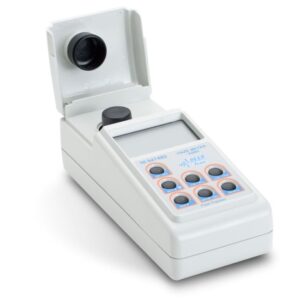
Hanna also offers application-specific portable meters. The HI847492 is a dedicated haze meter for the brewing industry, displaying readings in FTU, EBC, ASBC, and HELM units. The HI93124 is a portable EBC haze meter designed specifically for monitoring bentonite fining in wine production.
For field work that demands more than turbidity alone, the HI9829 multiparameter meter measures up to 14 water quality parameters, including turbidity, pH, ORP, conductivity, and dissolved oxygen, with an optional GPS for location tracking.
Industry | Why Turbidity Matters | Typical Instruments |
Drinking water treatment | Regulatory limit often set at 1 NTU or below after filtration; turbidity indicates filter performance | EPA benchtop or portable turbidimeter |
Wastewater and effluent | Discharge permits require turbidity below set thresholds; monitors settling pond efficiency | Portable turbidity sensor or multiparameter meter |
Food and beverage | Haze levels in beer and wine affect product clarity and consumer perception | HI847492 haze meter, HI93124 EBC haze meter |
Environmental monitoring | Sediment runoff in rivers and lakes affects aquatic ecosystems and indicates erosion | ISO portable turbidimeter, HI9829 multiparameter |
Pharmaceutical production | Water purity requirements for process water and cleaning validation | Benchtop turbidimeter with GLP logging |
Accurate turbidity readings depend on proper calibration. All Hanna turbidimeters ship with or accept AMCO-AEPA-1 primary turbidity standards that are prepared from NIST-traceable reference materials. Each set of standards comes with a certificate of analysis that includes the lot number, reference values, and expiration date for full traceability.
To maintain measurement accuracy over time, follow these practices:
Replacement turbidity meter accessories, including lamps, cuvette caps, and calibration standards, are available separately.
Since 1978, Hanna Instruments has designed and manufactured analytical instruments in-house. Every turbidity sensor goes through a controlled production process from initial design to final quality check. The company holds both ISO 9001 and ISO 14001 certifications, covering quality management and environmental management across its manufacturing operations.
Hanna’s Singapore office provides local support, including product demonstrations, calibration advice, and after-sales service. For questions about which turbidity sensor fits your application, contact us or call (65) 6296-7118.
A turbidity sensor is an optical instrument that measures how cloudy or hazy a liquid is. It works by shining a beam of light through a sample contained in a glass cuvette. Suspended particles in the liquid scatter the light in different directions. A photodetector positioned at a 90-degree angle to the light source measures how much light is scattered. The more particles present, the more light is scattered and the higher the turbidity reading. A built-in microprocessor converts the scattered light signal into a numerical value expressed in units like NTU, FNU, or FTU.
NTU (Nephelometric Turbidity Units) and FNU (Formazin Nephelometric Units) both measure turbidity using the same 90-degree detection angle, but they differ in the light source used. NTU readings come from instruments using a visible-light tungsten lamp as specified by EPA Method 180.1. FNU readings come from instruments using an infrared LED as specified by ISO 7027. In practice, NTU and FNU values for the same sample may differ slightly because coloured dissolved substances can interfere with visible-light measurements but not with infrared measurements.
Calibration frequency depends on your quality management system and the regulatory standards you follow. As a general guideline, many laboratories calibrate their turbidity sensors daily or before each batch of measurements. High-throughput facilities may calibrate at the start of every shift. At a minimum, recalibrate whenever you change the lamp or cuvette, when the instrument has been stored for an extended period, or when quality control checks show readings drifting outside your accepted tolerance range.
No. ISO 7027 and EPA 180.1 specify different light sources, so a single turbidimeter cannot be compliant with both standards at the same time. An ISO-compliant meter uses an infrared LED, while an EPA-compliant meter uses a tungsten lamp in the visible spectrum. If your work requires compliance with both standards, you will need two separate instruments or a dual-method model where available.
Most drinking water regulations set turbidity limits at or below 1 NTU after filtration. The US EPA requires that at least 95% of samples taken each month must be below 0.3 NTU for systems using conventional or direct filtration. The World Health Organization recommends turbidity below 1 NTU for effective disinfection. Singapore’s drinking water quality standards also require turbidity to remain well below 1 NTU. An EPA-compliant turbidimeter with accuracy down to 0.02 NTU is typically needed for this type of testing.
In most practical contexts, the terms are interchangeable. A nephelometer specifically refers to an instrument that detects light scattered at 90 degrees to the incident beam, which is the standard detection angle for both ISO 7027 and EPA 180.1. “Turbidimeter” is the broader term that covers any instrument designed to measure turbidity, including those with additional detection angles such as ratio turbidimeters. Ratio turbidimeters use multiple detectors (typically a 90-degree detector plus a transmitted-light detector) to compensate for colour interference and lamp intensity fluctuations, improving accuracy at both low and high turbidity ranges.
Turbidity sensors do not directly measure TSS. Turbidity is an optical property (how much light is scattered), while TSS is a gravimetric measurement (the mass of particles per volume of water). However, there is a strong correlation between turbidity and TSS in many water sources, so turbidity readings are commonly used as a real-time proxy for TSS. To establish a reliable correlation, you need to collect paired turbidity and lab-analysed TSS data from your specific water source over time.
Choose a benchtop turbidimeter if your testing happens in a fixed laboratory setting and you need high sample throughput, wider measurement ranges, or the ability to measure additional parameters like chlorine alongside turbidity. Choose a portable turbidity meter if you need to take readings at field sites such as water treatment plants, reservoirs, rivers, or industrial discharge points. Portables are battery-powered, lighter, and built to handle outdoor conditions.
To empower customers to achieve quality
by supplying intuitive, accurate, and reliable analytical instruments with exceptional customer service and value.
We take pride in every product we build. From an original idea, to a completed product ready for testing. We oversee every aspect of the manufacturing process. It is this level of attention to detail that sets us apart.